

In a modest facility in Stratford, east London, the British start-up Better Dairy is producing cheese without using any animal milk, claiming it closely mimics the taste of traditional cheese.
Better Dairy is among a few companies worldwide aiming to introduce lab-grown cheese into consumers’ diets within the coming years.
However, recent data from the Agriculture and Horticulture Development Board (AHDB) shows a decline in the popularity of meat-free products. Plant-based cheese sales in the UK dropped by 25.6% during the first quarter of 2025, while sales of conventional dairy cheese increased by 3%.
One explanation offered by the AHDB is that the number of vegans in the UK is relatively small—estimated at about 1% by the AHDB and 3% by the Vegan Society—and this figure has recently slightly decreased.
The Vegan Society, however, maintains that the plant-based food sector remains competitive and stable.
Hille van der Kaa of Those Vegan Cowboys describes a “silent revolution” in which lesser-known cheeses are being replaced with vegan alternatives. The company plans to launch its cheeses in the US later this year, with a European launch expected within three to four years, pending regulatory approvals as lab-grown cheeses are considered “novel foods” requiring EU authorization.
Van der Kaa acknowledges the current low demand for vegan cheese but aims to introduce substitutions in products like frozen pizzas, where consumers rarely consider the cheese type, making the swap easier.
Similarly, French company Standing Ovation plans to debut in the US next year and enter the UK and European markets by 2027.
Better Dairy in London has not yet launched its lab-grown cheese, citing current high production costs. CEO Jevan Nagarajah aims to release the product within three to four years at a price comparable to artisanal cheeses, eventually matching supermarket prices.
Better Dairy focuses on cheddar, identifying hard vegan cheeses as having the largest quality gap compared to their dairy counterparts. Though they have experimented with blue cheese, mozzarella, and soft cheeses, they believe dairy proteins affect these less in terms of taste.
Their production uses genetically engineered yeast that produces casein—the key milk protein—through precision fermentation, similar to methods used for insulin production. Other companies utilize bacteria or fungi for casein production.
Once produced, the casein is combined with plant-based fats and other milk components before undergoing traditional cheese-making processes.
After tasting Better Dairy’s cheddars aged three, six, and twelve months, the flavor closely resembled real cheese. The younger cheeses were slightly rubbery, while the older ones had a noticeable saltiness. The cheese melted well on a burger.
Nagarajah admits there’s room for improvement and envisions artisanal cheesemakers using their non-dairy “milk” base to enhance flavors.
Since dairy fats cannot be used, Better Dairy has optimized plant-based fats to improve taste, avoiding common off-flavors from nut or coconut fats, explains scientist Kate Royle.
Those Vegan Cowboys continues focusing on easily replaceable cheeses found in pizzas and burgers, while Standing Ovation’s casein technology supports a variety of cheeses including camembert.
Will lab-grown cheeses succeed? It’s a challenging market. According to an AHDB survey, 40% of consumers who purchased vegan cheese didn’t buy it again, indicating taste may deter repeat purchases.
Damian Watson of the Vegan Society points out that some vegans prefer foods that replicate animal products, while others want distinctly different options.
Judith Bryans, CEO of Dairy UK, believes traditional dairy will maintain its market share, emphasizing uncertainty about how lab-grown products will fit consumer preferences and pricing.
Both Better Dairy and Those Vegan Cowboys are partnering with established cheese producers to scale production and reduce costs. Standing Ovation has partnered with Bel, makers of BabyBel cheese.
Standing Ovation’s CEO, Yvan Chardonnens, describes the recent drop in popularity as an initial phase of vegan cheese analogues struggling with quality, which he expects to improve in the coming years.
In addition to the shrinking vegan market, these companies must address concerns over ultra-processed foods. They argue lab-grown cheese’s lack of lactose, cholesterol, and lower saturated fat content could make it healthier, and note that all cheese is processed to some extent.
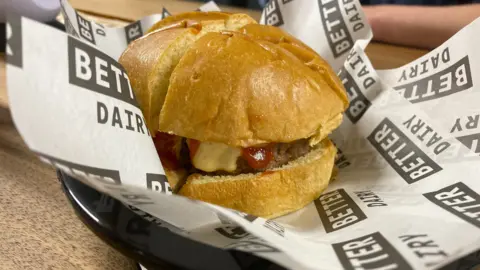
Precision fermentation may help eliminate many ultra-processed ingredients found in current vegan cheeses.
Hille van der Kaa suggests consumer perceptions need to change, pointing out the romanticized view of dairy farming despite it being highly industrialized today—a notion supported by AHDB research showing 71% of consumers consider dairy “natural.”
“We have an important role in educating people on how cheese is produced in the modern era,” she says.
ALSO READ : How to Manage Your Finances While Living and Working Abroad
