
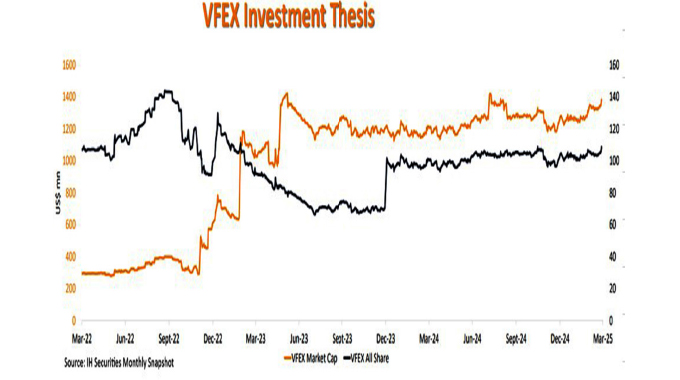
Zimbabwe’s capital markets showed mixed results in March, with being the Victoria Falls Stock Exchange (VFEX) keeping its upward trend and Zimbabwe Stock Exchange (ZSE) had mixed results, characterized by lower real-time performance and a decrease in activity.
The VFEX experienced a major rebound in sentiment towards the market during March. The market capitalisation grew by 7.41 percent over February and was at US$1.40 billion. Its VFEX All Share Index also increased by 3.98 percent to close at 110.32 points, extending the gains of the month before.
Padenga Holdings was the top performer, rising by 17 percent following the decision to announce a strategy purchase of the rest of 49.9 percent of Dallaglio’s shares issued through an exchange of shares. The market was pleasantly receptive to the consolidation, interpreting it as an enhancement in value.
First Capital Bank and Innscor reported increases in the range of 11.13 percent and 8.81 percent, respectively.
However, Zimplow was the notable underperformer, having lost 21 percent of its value.
Despite the upbeat price trend, trading activity on VFEX was down significantly. Volumes fell by nearly 98 percent in the range of 26.72 million shares, while turnover dropped by 99.99 percent to US$2.53 million. The decrease is a result of a normalization of business following the huge First Capital Bank block trade in February, which overinflated the figures of the previous month.
Participation of foreign investors was modest, with purchases from foreign investors amounting to USD12 811.99 and sales of US$891 133.20.
However, the pipeline for the future listing of the VFEX is still strong despite the removal of National Foods in February. The confidence of investors is maintained by the stability of pricing and the continued appeal of counters based on hard currency.
IH Securities commented in their market analysisthat “Forward-looking as the prices on the bourse have been stable. We anticipate that for April, that activity will be aided by dividend reinvestments made from the year-ends of December that we recently released. If there isn’t any the capital market appreciation that we have seen, it will push us to invest in defensive stocks that have solid dividend policies.”
The ZSE saw moderate gains for local currency however saw declines in the real world due to fluctuations in exchange rates. The market capitalisation on the ZSE increased by 1.83 percent in a month, up to ZiG 63.13 billion. But, if converted to USD the value dropped in 3.44 percentage to US$1.7 billion.
Performance of the index on ZSE was also varying. There was a variation in the performance of indexes on ZSE.
All Share Index slightly increased to 205.25 from February, and it’s Top Ten Index declined by 2 percent to 200.55. Its Mining Index also weakened, declining to 193.56 during February, to 180.43 at the end of March.
The top performers on ZSE comprised Nampak, TSL, and Willdale, who gained the most by 107 percent, 42 percent, 32 percent, and 107 percent, respectively. Mashonaland Holdings was the worst performer, having lost 24,4 percent of the value it trades for.
The trading activity at the ZSE was generally lower in comparison to February. The monthly trading volume dropped to 52.9 per cent up to 92.89 million shares which included Star Africa accounting for over 50% of the volume, which was 47.76 millions shares. Econet and Delta were next in the second place with 18.71 million shares and 9.18 million traded shares respectively.
Turnover exhibited a similar pattern. In nominal terms the average value per day traded fell in 56.13 per cent in the month of March to ZiG11.6 million.
In terms of real USD the turnover was more than half in the month of March, by US$15.03 million at the end of February and US$6.97 million in March. Delta and Econet were the two value leaders in the market and continue to draw a steady stream of investors.
International investor flow also dipped in foreign investment, with foreign purchases reaching ZWG 6.65 million and sales of ZWG 9.04 million.
Shares bought or sold to foreign companies sat in the 494-100 range and 1.65 million and 1.65 million, respectively. This is a substantial reduction from February’s foreign exchange activity.
IH Securities further noted: “In our opinion how the ZSE is heavily dependent on the dynamics of the money supply. In light of the uncertain political environment we prefer firms that are agile and able to manage the current economic climate and, when there are no capital gains, companies who are consistently dividend-paying.”
The different performance that were recorded by VFEX and the ZSE as well as VFEX in March show the different preferences of investors as well as liquidity conditions on both platforms. Although the VFEX continues to draw attention due to its strong exchange rate and price stability however, the ZSE is still susceptible to currency depreciation as well as policy uncertainty.
But, dividend-paying counters are an important point of interest for investors who are trying to navigate these difficult market conditions.
